The SEC Wants to Know What AI You Run
tl;dr
- The exam question changed: SEC examiners will now check whether firms have policies to monitor and supervise their AI use, not just whether their AI marketing is accurate.
- Scope is wider than trading: The priorities name fraud detection, back-office operations, and anti-money laundering (AML) alongside trading.
- No new rule is coming: The SEC withdrew its AI conflicts proposal in 2025. The standard is your existing compliance program.
- Homegrown automation is the blind spot: Tools built by junior staff in personal accounts touch regulated data without anyone classifying them that way.
- The fix is a register, then a tier: List every automation with a model in the loop, then add logging and a human check for anything investor-facing or regulated.
Picture the exam letter arriving. One line asks the firm to describe its use of artificial intelligence and the policies that govern it. The Chief Compliance Officer (CCO) pulls the AI policy, the acceptable-use memo, and the vendor list. Then someone in operations mentions the expense tagger a junior analyst built last spring. It sends each invoice line to a language model every night and posts whatever category comes back. Nobody has looked at it since she moved to a different desk.
That moment is what the SEC’s fiscal year 2026 examination priorities put on the calendar. The SEC has looked at AI before, mostly to check whether firms overstated what their AI did. This year adds a harder question: does the firm have adequate policies to monitor and supervise how it actually uses AI, including in functions that have nothing to do with picking investments?
This article covers what the SEC said, why the lack of an AI rule makes the exam harder, and why the way many advisers adopted AI creates a gap a written policy doesn’t close. It ends with what a defensible answer looks like.
What the SEC Actually Said
The Division of Examinations released its FY2026 priorities on November 17, 2025, the first set under Chairman Paul Atkins.[1] The document is a staff statement, not a rule. It creates no new obligations.[2] What it does is tell firms where examiners will spend their time, and on AI the language is specific.
Under “Emerging Financial Technology,” the Division says it will review the accuracy of firms’ statements about their AI capabilities. The Division will assess whether firms have adequate policies and procedures to monitor and supervise their use of AI, including for fraud prevention and detection, back-office operations, AML, and trading.[2]
Read that list again. Trading is last. The other three are operational functions where AI arrives quietly, through an analyst piloting a screening tool or an operations team adding a language model to a workflow. The priorities also say examiners will consider how firms use technology to automate internal processes.[2] Internal automation is in scope.
The practical question is supervision. An examiner will want to see that the firm knows what AI it runs, what those systems touch, and who checks their output. A policy that describes supervision without evidence to support it is exactly the gap examiners have flagged for years.
Why No New Rule Makes This Harder
It’s tempting to read the absence of an AI rule as breathing room. The opposite is closer to the truth. In 2023 the SEC proposed a rule on conflicts of interest from “predictive data analytics,” its term for AI-driven tools. On June 12, 2025, the Commission withdrew that proposal along with 13 others and said it does not intend to finalize them.[3] Chairman Atkins has since urged the Commission to resist writing a new disclosure rule for every new technology.
So there’s no AI rule. There is Rule 206(4)-7, adopted in 2003. It requires every registered adviser to adopt written policies reasonably designed to prevent violations of the Advisers Act, to review them at least once a year, and to name a CCO to run them.[4] That rule doesn’t care whether the risk comes from a spreadsheet, a vendor platform, or a language model. If an AI system influences a regulated activity and the compliance program doesn’t address it, the program isn’t reasonably designed for the firm’s actual operations.
The SEC has already used existing rules on AI. In March 2024 it settled charges against two advisers, Delphia and Global Predictions, for false statements about their use of AI. They paid $225,000 and $175,000 for violating the Marketing Rule of the Investment Advisors Act and for making false and misleading statements.[5] No new regulation was needed. The SEC applied an old standard, say what you do and do what you say, to a new subject.
Keep this in proportion. The cases so far target public misstatements, not internal operations. A supervision gap in a back-office automation is far more likely to appear in a deficiency letter, the written findings that close most exams, than in an enforcement action. Atkins said exams should not be a “gotcha” exercise.[1] The risk isn’t a fine. It’s a finding that the compliance program didn’t cover what the firm actually runs, and the remediation that follows.
FINRA, which oversees broker-dealers, took the same view in its 2026 Annual Regulatory Oversight Report, which added a section on generative AI and, for the first time, on AI agents (systems that carry out multi-step tasks). Its rules are technology-neutral: supervision and recordkeeping obligations apply regardless of the tool.[6] One distinction matters. FINRA’s rules are prescriptive and apply to the brokerage side of a dually registered firm. An adviser answers to the principles-based standard in Rule 206(4)-7 and can size controls to its own risk. For an adviser-only firm, the FINRA report is a preview, not a checklist.
A prescriptive rule tells what to document. A principles-based standard says the documentation has to fit your firm. That’s harder when nobody can say with confidence what AI the firm runs.
The Graduate Model and the Gap It Creates
Here’s how AI enters a lot of mid-sized adviser firms. Call it the graduate model. The firm hires recent graduates who are fluent with language models and no-code automation platforms (tools that let non-programmers connect data and actions without writing software). Leadership encourages experimentation. Within a quarter, each department has automations that save real time: a workflow that drafts investor update emails from portfolio data, a language-model step that pulls valuation inputs out of broker quotes, a model that reads invoice lines and assigns expense categories.
A scoping note: A job that runs fixed rules or a formula is ordinary software, and your IT controls already cover it. What changed is automations with a model in the middle, whose output can vary with the very same input and whose reasoning nobody can inspect. Those are the automations this article is about.
Each one is individually reasonable. Together they share four traits that matter on exam day.
They live outside IT’s inventory. They were built in a personal account or on a no-code platform paid for with a credit card. They aren’t on the vendor list because the firm never procured them.
They touch regulated data without being labeled that way. Investor communications, allocations, valuation inputs, and expense tagging all sit inside regulated processes. The builder saw a productivity tool. Compliance never saw it at all.
They have no version history. When a prompt or a model changes, the old behavior is gone. If an examiner asks what the automation did on a given date, there’s no way to reproduce the answer.
They outlive their builders. The analyst moves desks or leaves. The automation keeps running with no owner, and the only person who understood it isn’t available.
None of this is negligence. It’s what fast, bottom-up adoption looks like. But a compliance program is supposed to know which systems touch regulated activity. The graduate model produces systems that touch it by design and escape the inventory by accident. The CCO ends up answering “what AI do you use” with a list of vendor platforms that misses the dozen automations doing the actual work.
What the Numbers Say
The 2026 Investment Management Compliance Testing Survey, from the Investment Adviser Association, ACA Group, and Yuter Compliance Consulting, found that 85% of adviser firms named AI their top compliance topic. Eighty percent have adopted AI tools, and 86% keep an inventory of them. But only 48% have a formal procedure for human oversight of AI outputs, and only 37% test and validate those outputs.[7] Most firms can list their tools. Fewer than half can show that a person checks what the tools produce.
Two caveats. The survey is self-reported. More important, a list of licensed AI tools is not a list of AI-influenced processes. The firm that lists its chatbot subscription has an inventory. The firm whose list includes the nightly expense tagger has a register. That difference is the whole point.
Workforce data shows why the two diverge. A 2026 Okta study of 292 executives and 492 knowledge workers found 52% of workers using AI tools their employer hadn’t approved (67% in the United States), while 90% of executives said they were confident in their visibility into AI use.[8] That’s a general survey, not an adviser survey, but the gap is unlikely to be smaller at a firm that hired for AI fluency.
What Governed Automation Looks Like
The fix doesn’t require a new platform or a committee. It requires a register and a tier.
The register
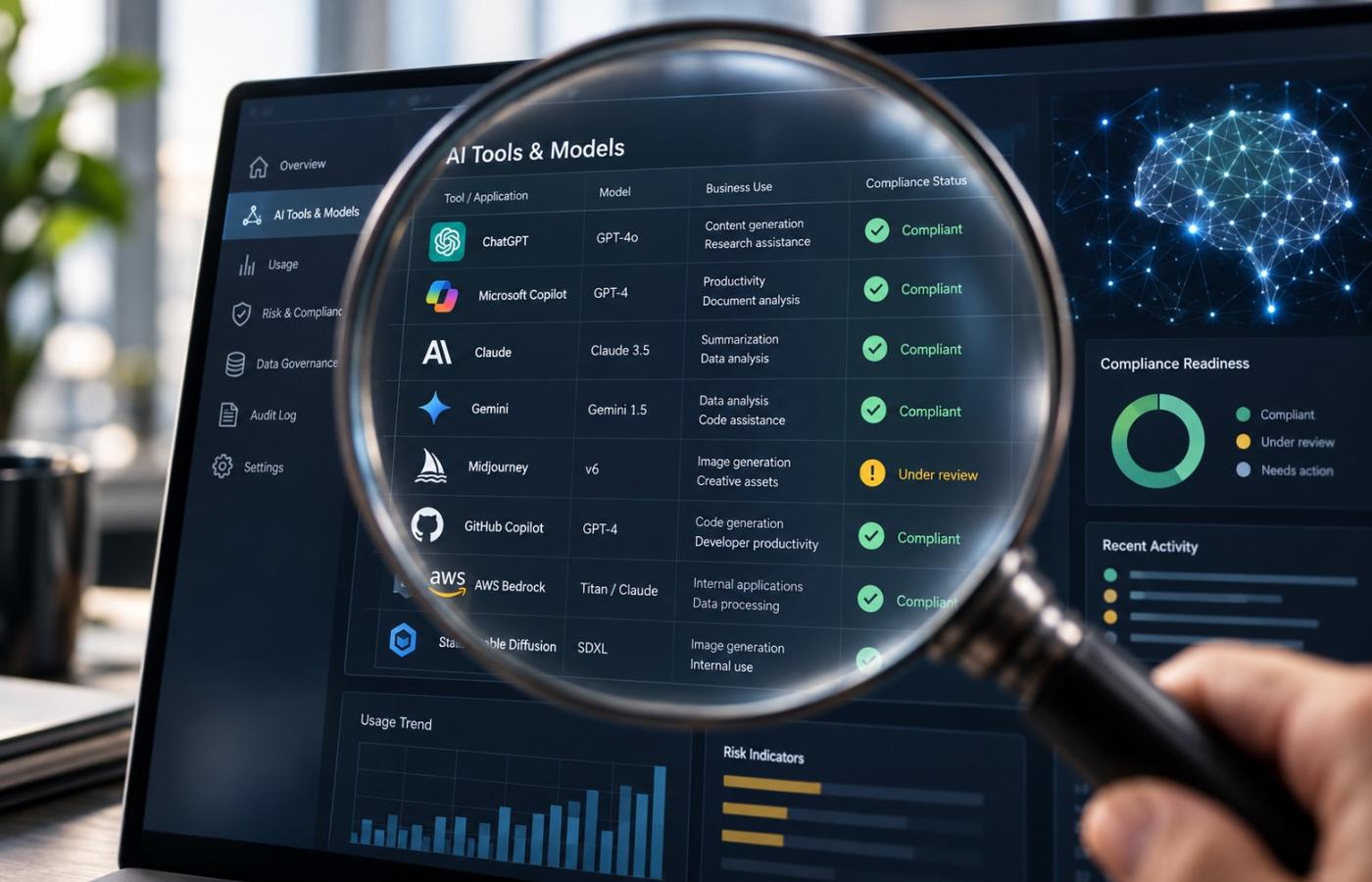
The register is one list of every automation with a model in the loop, procured or homegrown. It is not a list of every macro in the firm. Keeping it to model-driven automations keeps it short enough to maintain. Each entry carries five fields:
- Owner: A named person accountable today, not the person who built it.
- Data read and written: What it pulls from and what it changes.
- Decision influenced: What outcome the output feeds, in plain words. “Drafts investor letters for review.” “Posts expense categories without review.”
- Model and prompt version: A dated copy of the prompt text and the model name, saved whenever either changes. No developer tools required.
- Last review date: When someone last confirmed it does what the register says.
The hard part isn’t the template. It’s discovery. Ask each department head what runs on a schedule, what touches client or fund data, and what would break if a particular junior employee left tomorrow. The last question is the most productive one. Then check the answers against evidence, since managers don’t know what their staff use. Three sources catch most of what interviews miss: expense reports, which surface AI subscriptions nobody procured; single sign-on logs, which show which AI services staff log into; and a review of integrations connected to the CRM, portfolio, and accounting systems. A small firm can do all three in a week.
The tier
Once the register exists, sort it. Anything that touches investor communications, allocation, valuation, trading, or AML gets the full treatment: output logging so the firm can show what the automation produced and when, and a human check before the output takes effect. Everything else gets reviewed on a cycle, and nothing more.
Size the human check to the volume. For an investor letter, a person reads it before it goes out. For an automation that categorizes thousands of expense lines a month, approving each one would erase the gain, and it wouldn’t work anyway. Reviewers asked to approve hundreds of outputs a day stop reading and start clicking, a pattern called automation bias. For high-volume work, use a random sample from the log, reviewed daily or weekly by someone who can spot a wrong answer, with an error threshold that pauses the automation. That’s a control an examiner can test. A rubber stamp isn’t.
This keeps the program proportionate. A job that reformats meeting notes doesn’t need controls. A workflow that proposes fund expense allocations does. It also answers the exam question directly. “What AI do you use” is the register. “How do you supervise it” is the tier, the logs, and the review dates. The annual review required by Rule 206(4)-7 is the natural place to refresh both.[4] Never-examined and recently registered advisers remain explicit priorities, so firms in either group have the most reason to start now.[2]
Final Thoughts
The SEC didn’t write an AI rule, and it didn’t need to. It told examiners to ask whether firms can supervise the AI they use, across operational functions most compliance programs haven’t mapped, and it left “adequate” to the existing standard: policies reasonably designed for the firm’s actual operations. That standard is only as good as the firm’s knowledge of its own systems.
The graduate model is fast, cheap, and good at producing automations. It’s also good at producing automations nobody can find. The industry has done the easy part: naming AI a priority and listing the tools it bought. The harder part is the register of what actually runs, who owns it, and what it touches, followed by a tier that puts logging and a human check where they belong.
If your CCO can produce that register today, you’re ahead of most of the industry. If the answer is “we have an AI policy,” the exam question this year is whether the policy describes a firm that exists.
References
- SEC Division of Examinations Announces 2026 Priorities – U.S. Securities and Exchange Commission
- Examination Priorities: Fiscal Year 2026 – SEC Division of Examinations
- Conflicts of Interest Associated with the Use of Predictive Data Analytics by Broker-Dealers and Investment Advisers (Withdrawal) – U.S. Securities and Exchange Commission
- 17 CFR § 275.206(4)-7 Compliance procedures and practices – Cornell Law School Legal Information Institute
- SEC Charges Two Investment Advisers with Making False and Misleading Statements About Their Use of Artificial Intelligence – U.S. Securities and Exchange Commission
- 2026 FINRA Annual Regulatory Oversight Report – FINRA
- AI Dominates Compliance Priorities at Historic Margin as Firms Move from Awareness to Action – ACA Group, Investment Adviser Association, and Yuter Compliance Consulting
- Bosses blinded by confidence about shadow AI use by workers – The Register, reporting on Okta’s AI Agents at Work 2026 study